
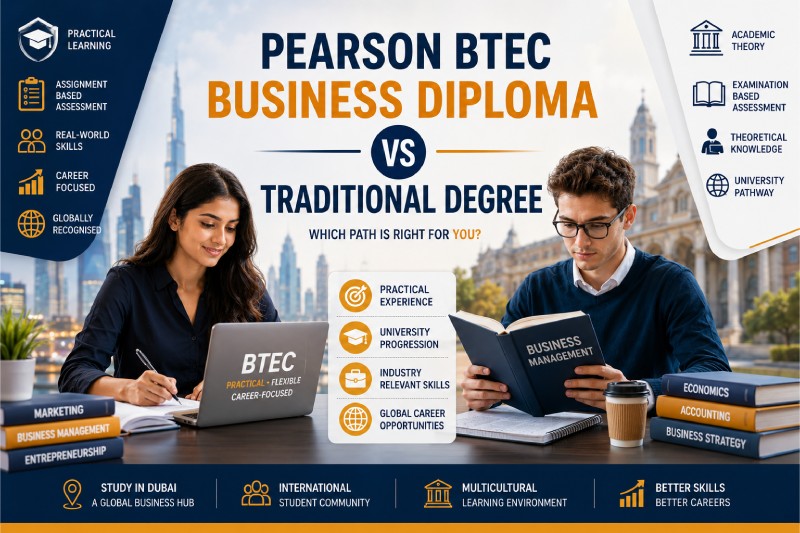
Pearson BTEC Business Diploma vs Traditional Degree: Which Is Better in 2026?
Choosing the right business qualification is an important decision for students and parents. The course selected after school can influence future university options, career opportunities, learning experience, and the practical skills a student develops before entering the workplace.
Two common pathways are a Pearson BTEC Business Diploma and a traditional university degree. Both can support academic and professional progression, but they differ significantly in teaching style, assessment methods, course structure, entry stage, and the way students prepare for employment.
A traditional business degree usually follows an academic model built around lectures, theoretical concepts, examinations, essays, and independent research. A Pearson BTEC Business qualification places greater emphasis on practical assignments, workplace scenarios, presentations, projects, and the application of business concepts to realistic challenges.
This does not mean that one option is automatically better for every student. The right choice depends on how the learner prefers to study, their current academic level, career goals, confidence with examinations, and plans for university progression.
For students who enjoy learning through practical activities and continuous assessment, a Pearson BTEC pathway can offer an engaging alternative to heavily examination-based education. Students who prefer academic research, theoretical analysis, and a conventional university experience may feel more comfortable with a traditional degree.
This guide compares both pathways clearly, helping students and parents understand the differences in learning, assessment, skills development, university progression, and career preparation before making a decision.
What Is a Pearson BTEC Business Qualification?
Pearson BTEC qualifications are career-focused programmes developed by Pearson in the United Kingdom. They are designed to combine academic knowledge with practical learning, helping students understand how business concepts are applied within real organisations.
Instead of relying mainly on final examinations, students are commonly assessed through assignments, presentations, business reports, case studies, research tasks, projects, and practical activities completed throughout the programme.
Within a Business qualification, students may explore areas such as marketing, finance, human resource management, entrepreneurship, business operations, leadership, customer service, organisational behaviour, and strategic decision-making.
Students are encouraged to analyse business problems, evaluate possible solutions, present recommendations, and communicate ideas professionally. This develops both subject knowledge and transferable skills that are useful in higher education and employment.
Pearson BTEC Business pathways are available at different levels. Students may begin with a Level 2 qualification, progress to a Level 3 Extended Diploma, and later continue to a Higher National Diploma in Business, depending on their academic background and eligibility.
This flexible structure allows students to build their education gradually while keeping progression routes open. A learner may continue to higher-level study, pursue a university pathway, or begin developing professional experience after completing the appropriate qualification.
At Regent Middle East, students can explore Pearson BTEC Business programmes delivered through practical learning at the institution’s campus in Dubai Knowledge Park.
What Is a Traditional Business Degree?
A traditional business degree is usually an undergraduate programme awarded by a university. It commonly takes three or four years of full-time study, depending on the country, institution, and programme structure.
Students typically study subjects such as economics, accounting, marketing, management, finance, business law, organisational behaviour, operations, and strategy. Some degrees also allow students to specialise in a particular field during the later stages of the programme.
The learning model generally includes lectures, seminars, academic reading, written essays, examinations, presentations, and independent research. Assessment methods vary between universities, but final examinations and academic assignments often contribute significantly to overall results.
Traditional degrees are well suited to students who enjoy academic study, theoretical discussion, structured lectures, and independent research. They can also provide access to postgraduate qualifications and professional career pathways.
However, the level of practical exposure can differ considerably between institutions. Some universities include internships, simulations, consultancy projects, or industry placements, while others remain more focused on academic theory and classroom-based learning.
Students considering a traditional degree should therefore review the curriculum carefully rather than assuming that every business degree provides the same learning experience or level of career preparation.
The institution, course content, accreditation, teaching quality, industry connections, and progression opportunities are often just as important as the qualification title itself.
Why More Students Are Comparing BTEC Business with Traditional Degrees
The needs of students and employers are changing. Academic knowledge remains important, but organisations increasingly expect graduates to demonstrate communication, teamwork, leadership, adaptability, problem-solving, digital awareness, and the ability to apply knowledge in practical situations.
This has encouraged more families to compare traditional academic pathways with career-focused qualifications such as Pearson BTEC Business.
Some students perform well in examinations but struggle to apply their knowledge beyond the classroom. Others understand business concepts clearly through assignments, presentations, projects, and real-life examples but may not achieve their best results under examination pressure.
The growing popularity of project-based and assignment-based education reflects the understanding that students learn in different ways. A practical pathway can allow learners to demonstrate progress consistently instead of depending heavily on performance during a small number of final examinations.
Cost, programme duration, flexibility, university progression, and employability also influence the decision. Students want to understand whether a qualification can help them continue to a degree, build workplace skills, and prepare for career opportunities without limiting their future options.
International students considering Dubai are also comparing qualifications based on location, safety, industry exposure, affordability, and access to globally recognised education. Dubai’s business environment makes it an attractive place to study management, entrepreneurship, marketing, finance, and other commercial subjects.
As a result, the question is no longer simply whether a diploma or degree sounds more prestigious. The more useful question is which pathway provides the right learning experience, progression opportunities, and career preparation for the individual student.
Pearson BTEC Business vs Traditional Degree: A Side-by-Side Comparison
Although both Pearson BTEC Business qualifications and traditional university degrees prepare students for careers in business, they follow different learning models. Understanding these differences helps students choose the pathway that best matches their learning style, career ambitions, and future academic plans.
A Pearson BTEC Business qualification focuses on practical learning, continuous assessment, and real business scenarios. Students regularly complete assignments, presentations, case studies, reports, and projects that demonstrate their understanding throughout the programme.
Traditional university degrees generally place greater emphasis on academic theory, lectures, examinations, independent research, and written assessments. While practical projects may also be included, final examinations often contribute significantly to the overall grade.
Both qualifications develop valuable business knowledge, but the learning experience differs considerably. Students should therefore compare teaching methods, assessment styles, university progression opportunities, and career preparation before making a decision.
The best qualification is not necessarily the most traditional one—it is the one that aligns with the student's strengths, interests, and long-term career objectives.
Practical Learning vs Academic Theory
One of the biggest differences between Pearson BTEC Business qualifications and traditional university degrees is the way students learn.
Pearson BTEC programmes are designed around practical application. Students learn business concepts by solving realistic business problems, analysing case studies, preparing marketing strategies, conducting research, delivering presentations, and completing workplace-inspired assignments.
This approach encourages students to think critically while developing confidence, communication skills, teamwork, leadership, creativity, and professional problem-solving abilities.
Traditional university programmes usually begin with theoretical concepts before asking students to demonstrate understanding through essays, examinations, and academic research. This learning style suits students who enjoy structured lectures, reading academic literature, and analytical writing.
Neither approach is universally better. Instead, students should consider which learning environment allows them to perform at their highest potential.
Assignments vs Examinations: Which Assessment Style Suits You?
Assessment methods can significantly influence a student's educational experience. Some learners perform exceptionally well under examination conditions, while others demonstrate their knowledge more effectively through continuous coursework and practical assignments.
Pearson BTEC qualifications primarily assess students through assignments completed during the programme. These may include business reports, presentations, project work, research activities, business plans, reflective journals, case studies, and collaborative tasks.
This continuous assessment approach allows students to receive regular feedback from tutors and improve their work throughout the programme rather than depending entirely on performance during final examinations.
Traditional university degrees often include semester examinations alongside coursework. In many programmes, examinations contribute a significant percentage of the final grade, requiring students to demonstrate knowledge within a limited examination period.
Students who prefer continuous learning and regular assessment often appreciate the flexibility offered by Pearson BTEC programmes, while those who perform strongly in examinations may feel comfortable within a traditional university structure.
Industry Skills vs Academic Knowledge
Today's employers are looking for graduates who can contribute from their first day in the workplace. While academic knowledge remains important, organisations increasingly value practical skills, communication, collaboration, adaptability, leadership, and problem-solving.
Pearson BTEC Business qualifications are designed to develop these workplace competencies alongside business knowledge. Students regularly apply what they learn through projects, presentations, teamwork, business analysis, and practical assignments that mirror professional environments.
Traditional university degrees provide strong theoretical foundations and analytical thinking skills, particularly for students planning academic research or postgraduate education. However, the amount of workplace-focused learning varies depending on the university and programme.
Many employers value graduates who possess both academic understanding and practical experience. Students who complete project-based learning often build portfolios that demonstrate their abilities to future employers during recruitment.
Ultimately, career success depends not only on the qualification itself but also on the skills, experience, attitude, and continuous learning demonstrated by the graduate throughout their professional journey.
Career Opportunities After Completing a Pearson BTEC Business Qualification
One of the biggest questions students ask before choosing a qualification is, "What career opportunities will this give me?" The answer depends not only on the qualification itself but also on the knowledge, practical skills, and professional experience students develop throughout their studies.
Pearson BTEC Business qualifications are designed to prepare students for real workplace environments. Throughout the programme, students work on business reports, marketing plans, presentations, research projects, case studies, financial analysis, and teamwork activities that closely reflect the responsibilities found in modern organisations.
Graduates may explore careers in business administration, marketing, sales, customer relationship management, human resources, finance support, operations, retail management, logistics, project coordination, entrepreneurship, digital marketing, business development, and administrative management.
As students gain experience, they may progress into supervisory, management, consultancy, or leadership positions depending on their chosen industry and continuous professional development.
Because business knowledge is transferable across almost every industry, graduates enjoy flexibility that allows them to work in multinational companies, startups, government organisations, hospitality, banking, healthcare, technology, tourism, education, and many other sectors.
Can You Progress to University After Pearson BTEC?
Yes. One of the greatest strengths of Pearson BTEC qualifications is the opportunity they provide for academic progression. Students do not need to choose between practical learning and higher education—they can pursue both.
Many learners begin with a Pearson BTEC Level 2 qualification before progressing to Level 3 and later completing a Higher National Diploma (HND). After successfully completing an HND, students may continue towards a bachelor's degree through recognised university progression pathways, depending on the university's admission requirements.
This flexible structure allows students to build confidence gradually while developing both academic knowledge and practical workplace skills throughout their educational journey.
For many international students, this progression pathway provides an opportunity to study in Dubai before continuing to universities in the United Kingdom or other countries that recognise Pearson qualifications.
Students considering progression should always review the admission criteria of their preferred university, but Pearson BTEC qualifications are widely recognised and respected by many higher education institutions around the world.
Do Employers Recognise Pearson BTEC Qualifications?
Employer expectations continue to evolve. Today's organisations increasingly value graduates who combine technical knowledge with communication, teamwork, adaptability, leadership, and practical problem-solving skills.
Pearson BTEC qualifications have earned international recognition because they encourage students to demonstrate these workplace capabilities through continuous assessment and applied learning rather than relying solely on theoretical examinations.
Employers often appreciate graduates who can analyse business situations, prepare professional reports, communicate confidently, work within teams, and contribute effectively from the beginning of their careers.
While recruitment decisions always depend on the individual candidate, relevant experience, and employer requirements, a practical qualification can help students build portfolios and demonstrate their abilities during interviews.
Successful careers are built through continuous learning, professional attitude, industry exposure, and workplace performance. A recognised qualification provides an excellent foundation, but long-term success depends on how students apply their knowledge throughout their careers.
Which Students Benefit Most from Each Pathway?
There is no single qualification that suits every learner. The best educational pathway depends on the student's learning style, academic strengths, career ambitions, and preferred assessment methods.
Students who enjoy practical projects, presentations, teamwork, assignments, business simulations, and continuous assessment often thrive within a Pearson BTEC learning environment. They usually prefer demonstrating their abilities throughout the programme instead of relying heavily on final examinations.
Students who enjoy academic research, theoretical analysis, structured lectures, independent reading, and written examinations may feel more comfortable within a traditional university programme.
Parents should also remember that success is influenced by motivation, curiosity, commitment, and the quality of education rather than by the qualification title alone. Choosing a pathway that matches the student's strengths often leads to better academic performance and greater confidence.
Instead of asking which qualification is universally better, families should ask which learning approach will help the student develop the knowledge, skills, confidence, and career readiness needed to achieve their long-term goals.
Which Option Is Better for International Students?
International students often consider more than the qualification title when choosing where and what to study. Cost, location, safety, progression opportunities, teaching style, career preparation, and access to internationally recognised education all influence the final decision.
A traditional university degree may appeal to students who want a conventional academic experience and are ready to commit to a three- or four-year programme from the beginning. It can be suitable for learners who enjoy theoretical study, examinations, academic research, and a structured university environment.
A Pearson BTEC Business pathway can be attractive for students who prefer practical learning, assignment-based assessment, smaller academic steps, and the flexibility to progress from one qualification level to another.
Students may begin with a Level 2 or Level 3 Business qualification, progress to a Higher National Diploma, and later continue towards a bachelor's degree through recognised university progression routes, subject to the admission requirements of the chosen university.
This step-by-step approach can help international students build confidence, strengthen their academic skills, and gain practical business knowledge before progressing to higher-level study.
For students from India, Sri Lanka, Bangladesh, Nepal, Nigeria, South Africa, Oman, Tanzania, Kazakhstan, Russia, and other countries, studying in Dubai also provides access to an international education environment while remaining connected to one of the world's fastest-growing business centres.
Why Dubai Is an Ideal Place to Study Business
Dubai is one of the world's most internationally connected business destinations. The city is home to multinational companies, startups, financial institutions, hospitality groups, logistics businesses, technology companies, retail organisations, and entrepreneurial ventures operating across regional and global markets.
Studying business in Dubai allows students to observe how organisations operate within a competitive, multicultural, and rapidly changing economy. This exposure can help learners connect classroom concepts with real industries and professional environments.
Dubai also offers a strong ecosystem for entrepreneurship, innovation, digital transformation, tourism, finance, aviation, e-commerce, and international trade. Students interested in business management can therefore explore a wide range of industries while developing their professional interests.
For international students and parents, Dubai also offers modern infrastructure, public transport, global connectivity, multicultural communities, and a learning environment that welcomes students from different academic and cultural backgrounds.
Regent Middle East is located in Dubai Knowledge Park, one of the city's leading education communities. The location gives students access to an academic environment surrounded by universities, training institutions, business districts, and professional organisations.
Students can learn more about the advantages of studying in the UAE through Regent Middle East's Dubai as a Study Destination guide.
Why Choose Regent Middle East for Pearson BTEC Business?
Regent Middle East offers career-focused Pearson BTEC Business programmes designed for students at different stages of their academic journey. Learners can explore qualifications at Level 2, Level 3, and Higher National Diploma level, depending on their previous education and eligibility.
The programmes combine business knowledge with practical learning through assignments, presentations, case studies, business reports, research projects, and collaborative activities.
This approach helps students develop communication, leadership, teamwork, decision-making, analytical thinking, entrepreneurship, and professional presentation skills alongside their understanding of business concepts.
Students also benefit from an international campus environment, experienced faculty, academic guidance, industry-focused activities, and a location within Dubai Knowledge Park.
Those beginning their business education can explore the Pearson BTEC Level 2 Diploma in Business.
Students ready for a higher secondary-level pathway can review the Pearson BTEC Level 3 Extended Diploma in Business.
Learners planning to complete the first two years of higher education through a practical business qualification can explore the Pearson BTEC Higher National Diploma in Business.
By offering multiple entry and progression levels, Regent Middle East helps students choose a business pathway that matches their academic background, learning style, and long-term goals.
Frequently Asked Questions
Is a Pearson BTEC Business Diploma the same as a degree?
No. Pearson BTEC qualifications and university degrees are different types of qualifications. A BTEC can provide practical learning and progression opportunities, while a traditional degree is normally an undergraduate qualification awarded by a university.
Which is better, a BTEC Business qualification or a traditional degree?
The better option depends on the student's learning style, academic level, preferred assessment method, career goals, and progression plans. BTEC suits many practical learners, while traditional degrees may suit students who prefer academic theory and examinations.
Can I go to university after completing Pearson BTEC Business?
Yes. Many students progress from Pearson BTEC qualifications to higher education. Admission depends on the university, programme, qualification level, and entry requirements.
Is Pearson BTEC Business recognised internationally?
Pearson BTEC qualifications are recognised by many universities, employers, and education institutions internationally. Students should confirm specific admission or employment requirements with the relevant organisation.
Are Pearson BTEC Business programmes assignment-based?
Pearson BTEC programmes commonly use assignments, projects, presentations, case studies, research tasks, and practical activities as part of continuous assessment.
Does a traditional business degree include practical learning?
Some traditional degrees include internships, simulations, placements, and industry projects. However, the amount of practical learning varies between universities and programmes.
What careers can I pursue after studying Pearson BTEC Business?
Students may explore opportunities in marketing, administration, sales, human resources, operations, customer service, finance support, logistics, entrepreneurship, project coordination, and business development.
Can I study Pearson BTEC Business after Grade 10?
Students may be eligible for an appropriate Pearson BTEC level after Grade 10, depending on their academic background and the institution's admission requirements.
Can I study Business after Grade 12 in Dubai?
Yes. Students who have completed Grade 12 or an equivalent qualification may explore suitable Business programmes in Dubai, including Pearson BTEC Higher National qualifications, subject to eligibility.
Why should international students study Business in Dubai?
Dubai offers an international business environment, multicultural exposure, modern infrastructure, strong industry presence, and access to education providers located within dedicated academic communities such as Dubai Knowledge Park.
What Pearson BTEC Business programmes are offered by Regent Middle East?
Regent Middle East offers Pearson BTEC Business programmes at Level 2, Level 3, and Higher National Diploma level.
How can I apply to Regent Middle East?
Students can contact the admissions team, discuss their academic background and goals, submit the required documents, and receive guidance on the most suitable Business pathway.
Final Verdict: Pearson BTEC Business Diploma or Traditional Degree?
A Pearson BTEC Business qualification and a traditional degree can both lead to valuable academic and professional opportunities. The right decision depends on the individual learner rather than a single qualification being universally better.
A traditional degree may be suitable for students who prefer academic theory, examinations, independent research, and a conventional university pathway.
A Pearson BTEC Business qualification may be the stronger choice for students who prefer practical learning, continuous assessment, real business scenarios, flexible progression, and the opportunity to develop workplace-ready skills throughout the programme.
Students and parents should compare the curriculum, qualification level, teaching style, assessment method, institution, university progression opportunities, and career support before making a final decision.
At Regent Middle East, students can choose from multiple Pearson BTEC Business pathways delivered in Dubai Knowledge Park, allowing them to build their education according to their previous qualifications and future ambitions.
Explore Regent Middle East's career-focused courses in Dubai, speak with the admissions team, and discover which Business qualification best supports your academic and career goals.