
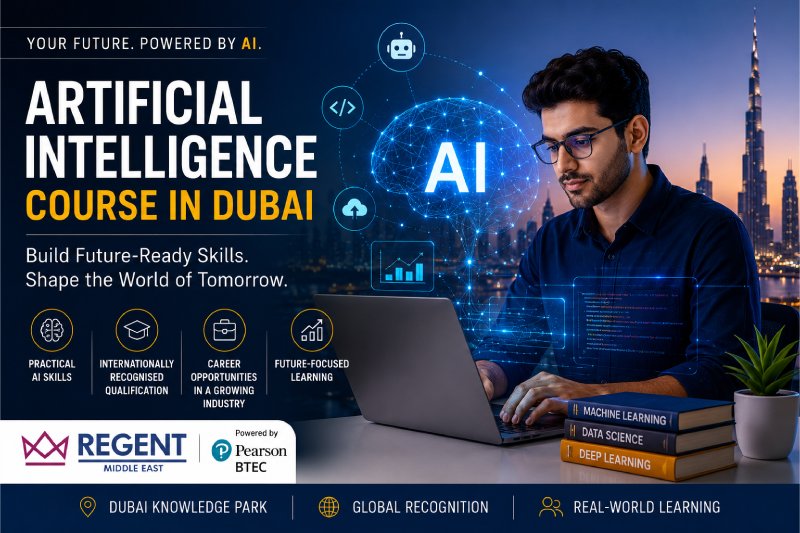
Why Study an AI Course in Dubai in 2026?
Artificial Intelligence is rapidly changing how businesses operate, how people communicate, and how industries make decisions. From automated customer service and smart healthcare systems to cybersecurity, finance, transport, marketing, and content creation, AI technologies are becoming part of everyday professional life.
For students planning a future in technology, choosing an AI course in Dubai can provide access to career-focused education within one of the region’s most innovative and internationally connected cities. Dubai continues to invest in digital transformation, smart services, automation, data-driven decision-making, and emerging technologies, creating a strong environment for students interested in Artificial Intelligence.
Studying AI is not only suitable for students who want to become programmers. Artificial Intelligence is increasingly relevant to business analysts, digital marketers, entrepreneurs, cybersecurity professionals, data specialists, project managers, hospitality professionals, and technology consultants.
An effective Artificial Intelligence course should therefore combine technical knowledge with practical problem-solving, communication, teamwork, and an understanding of how AI solutions can be applied across different industries.
Located in Dubai Knowledge Park, Regent Middle East offers a career-focused Pearson BTEC pathway in Artificial Intelligence Solutions and Applications. The programme is designed to help students understand digital technologies while developing practical skills through assignments, projects, research, presentations, and applied learning activities.
This guide explores what Artificial Intelligence means, why AI skills are becoming increasingly valuable, why Dubai is an attractive place to study technology, and how the right qualification can prepare students for future education and career opportunities.
What Is Artificial Intelligence?
Artificial Intelligence refers to the development of computer systems that can perform tasks normally associated with human intelligence. These tasks may include recognising patterns, analysing information, understanding language, predicting outcomes, making recommendations, and automating decisions.
AI systems are created using data, algorithms, software, and computing technologies. They are trained to identify relationships within information and use those relationships to generate useful outputs or support decision-making.
Some common examples of Artificial Intelligence include virtual assistants, recommendation systems, facial recognition, fraud detection, automated translation, navigation applications, chatbots, personalised advertising, and smart manufacturing systems.
Machine learning is one of the most important areas within Artificial Intelligence. It enables computer systems to learn from data and improve their performance without being programmed separately for every possible situation.
Other important areas include natural language processing, computer vision, robotics, data analytics, intelligent automation, and predictive modelling. These technologies are used across industries to improve efficiency, reduce repetitive work, understand customer behaviour, and support faster decisions.
For students, learning Artificial Intelligence involves more than understanding advanced technologies. It also requires logical thinking, creativity, research, data awareness, ethical responsibility, and the ability to identify problems that technology can help solve.
A career-focused AI programme introduces these concepts through structured learning and practical applications, helping students understand both how Artificial Intelligence works and how it can be used responsibly within real organisations.
Why AI Skills Are Becoming Essential Across Industries
Artificial Intelligence is no longer limited to specialist technology companies. Organisations across almost every sector are using AI-powered tools to improve productivity, strengthen customer experiences, manage information, and create new services.
In business and finance, AI can support market analysis, customer service, forecasting, fraud prevention, and risk assessment. In healthcare, intelligent systems can assist with medical imaging, patient monitoring, administration, and data analysis.
Hospitality and tourism companies use AI to personalise guest experiences, manage bookings, analyse customer preferences, and improve operational planning. Retail organisations use recommendation systems, demand forecasting, automated support, and customer analytics.
Cybersecurity teams apply Artificial Intelligence to detect unusual activity, identify threats, and respond to potential security incidents. Marketing professionals use AI for audience research, campaign analysis, content planning, and customer segmentation.
Because AI is being adopted across many industries, employers increasingly value professionals who can understand technology while also communicating clearly, solving problems, working in teams, and applying knowledge in practical situations.
Students who develop AI-related skills can explore opportunities in software, data, business intelligence, automation, digital transformation, cybersecurity, technology consulting, and project support. They may also use their knowledge to strengthen careers in non-technical fields where AI tools are becoming increasingly important.
This means that studying Artificial Intelligence can provide students with more than one fixed career route. It can create a flexible foundation that supports progression into several technology and business-related pathways.
As AI tools continue to develop, professionals will also need to understand responsible use, data privacy, fairness, transparency, and the social impact of automated decisions. A strong AI education should therefore balance technical learning with ethical awareness and professional responsibility.
Why Dubai Is Emerging as a Leading AI and Innovation Hub
Dubai has built a strong international reputation for innovation, smart infrastructure, entrepreneurship, and technology-led development. Government services, transport systems, financial organisations, tourism companies, and private businesses across the city continue to adopt digital tools and intelligent technologies.
This environment makes Dubai an attractive destination for students who want to study Artificial Intelligence while gaining exposure to a modern, technology-focused economy.
Students in Dubai are surrounded by companies operating in sectors such as finance, logistics, aviation, hospitality, tourism, cybersecurity, digital marketing, e-commerce, healthcare, and professional services. Many of these industries are exploring Artificial Intelligence to improve operations and create new customer experiences.
Dubai also offers a multicultural learning environment where students can study alongside classmates from different countries, cultures, and academic backgrounds. This international exposure helps learners develop communication, collaboration, and professional skills that are valuable in global workplaces.
For technology students, studying in Dubai provides an opportunity to understand how innovation is applied within real industries rather than learning concepts only in isolation.
Regent Middle East is located in Dubai Knowledge Park, a dedicated education community that brings together universities, colleges, training providers, students, and professionals. The location offers convenient public transport access and places learners within one of Dubai’s most established academic environments.
Students can explore the Pearson BTEC Level 5 HND in Digital Technologies – Artificial Intelligence Solutions and Applications to learn more about the programme available at Regent Middle East.
By combining an internationally recognised qualification, practical learning, and exposure to Dubai’s growing technology ecosystem, students can build a strong foundation for further education and future careers in Artificial Intelligence.
What Students Learn in an AI Course in Dubai
An Artificial Intelligence course is designed to help students understand how intelligent technologies are developed, implemented, and applied across different industries. Rather than focusing only on programming, modern AI education combines technical concepts with practical problem-solving, innovation, teamwork, and analytical thinking.
Students begin by developing a strong understanding of computing principles before progressing to topics such as intelligent systems, data analysis, automation, machine learning concepts, software development, cloud technologies, and digital transformation.
They also learn how AI technologies are applied within real organisations to improve productivity, customer experiences, operational efficiency, cybersecurity, healthcare, finance, logistics, hospitality, retail, and manufacturing.
Throughout the programme, students work on assignments, presentations, research activities, case studies, and practical projects that encourage them to analyse problems and develop technology-based solutions.
By combining theoretical understanding with practical application, students graduate with knowledge that is immediately relevant to higher education and future employment.
Technical and Professional Skills Developed Through an AI Programme
Employers today are looking for graduates who possess both technical expertise and professional workplace skills. An effective Artificial Intelligence programme therefore focuses on developing a balanced combination of technical knowledge and transferable abilities.
Students strengthen logical thinking, analytical reasoning, problem-solving, research techniques, communication skills, collaboration, project management, presentation skills, and professional documentation while completing practical coursework.
Technical learning may include data analysis, software development principles, databases, cloud computing, intelligent applications, automation concepts, cybersecurity awareness, and emerging digital technologies.
Professional skills are equally important. Students learn how to work within teams, communicate technical ideas to different audiences, manage projects, evaluate solutions, and apply ethical thinking when developing AI-based systems.
These capabilities prepare graduates to adapt to changing technologies throughout their careers while remaining valuable across multiple industries.
Pearson BTEC Level 5 HND in Artificial Intelligence at Regent Middle East
Students looking for an internationally recognised qualification can explore the Pearson BTEC Level 5 Higher National Diploma in Digital Technologies – Artificial Intelligence Solutions and Applications offered by Regent Middle East.
The programme has been developed to combine academic knowledge with practical learning, helping students build industry-relevant skills through assignments, projects, research activities, presentations, and applied learning rather than relying entirely on traditional examinations.
Delivered at Regent Middle East's campus in Dubai Knowledge Park, the programme provides students with access to a modern learning environment supported by experienced faculty, industry engagement, and an international student community.
The curriculum is designed to help students understand how Artificial Intelligence can solve real business and technology challenges while strengthening communication, teamwork, leadership, and critical thinking skills.
Upon successful completion, students may choose to continue their academic journey through recognised university progression pathways or begin building careers within rapidly growing technology sectors.
Students can learn more about the programme by visiting the official Artificial Intelligence course page.
Why Practical Learning Makes an AI Qualification More Valuable
Technology employers increasingly value graduates who can apply knowledge to real situations rather than simply recalling theoretical concepts. This is one of the reasons why practical education has become an important feature of modern Artificial Intelligence programmes.
Students learn more effectively when they solve real problems, analyse case studies, complete projects, collaborate with classmates, present ideas, and receive constructive feedback throughout their studies.
Pearson BTEC qualifications follow this practical learning approach by encouraging continuous assessment through assignments and applied activities. Students gradually build confidence while demonstrating their understanding across multiple forms of assessment.
This method not only strengthens technical knowledge but also develops communication, creativity, adaptability, leadership, and independent thinking — qualities that employers increasingly seek across today's technology sector.
By combining internationally recognised qualifications with practical experience, students are better prepared for university progression, internships, and future employment in Artificial Intelligence and related digital industries.
Career Opportunities After Completing an AI Course in Dubai
Artificial Intelligence has become one of the fastest-growing career fields worldwide. Organisations across technology, finance, healthcare, education, logistics, manufacturing, retail, hospitality, aviation, and government are increasingly adopting AI-powered solutions to improve efficiency, automate processes, and deliver better customer experiences.
As businesses continue their digital transformation journeys, the demand for professionals who understand Artificial Intelligence is expected to grow significantly over the coming years. Graduates with practical AI knowledge are no longer limited to software companies—they are finding opportunities across almost every major industry.
Students who complete an internationally recognised AI qualification can explore careers in machine learning support, data analytics, business intelligence, software development, automation, intelligent applications, cloud technologies, cybersecurity, and digital transformation.
Some graduates continue towards bachelor's degrees through university progression pathways, while others begin building experience through internships, junior technology roles, or graduate trainee programmes.
The versatility of Artificial Intelligence means that students develop skills that remain valuable across multiple industries rather than preparing for only one specific profession. This flexibility makes AI one of the most future-focused education choices available today.
Popular Artificial Intelligence Job Roles in Dubai and the UAE
The UAE continues to invest heavily in emerging technologies, creating demand for professionals who understand Artificial Intelligence, automation, and digital innovation. While many graduates begin with entry-level positions, career opportunities continue to expand as experience and technical expertise grow.
Some of the most popular AI-related career paths include Artificial Intelligence Developer, Machine Learning Associate, Data Analyst, Business Intelligence Analyst, Automation Specialist, AI Solutions Consultant, Junior Data Scientist, Software Developer, Cloud Technology Associate, Digital Transformation Executive, Technology Consultant, Robotics Support Specialist, Computer Vision Associate, and AI Project Coordinator.
Students who combine Artificial Intelligence knowledge with business, cybersecurity, cloud computing, or software development often enjoy even broader career opportunities because organisations increasingly seek professionals with multidisciplinary technology skills.
Strong communication, teamwork, analytical thinking, project management, and presentation skills also play an important role in helping graduates progress within technology-focused organisations.
As AI continues to influence more industries, professionals who can explain technical solutions to business users will remain highly valuable in the global workforce.
AI Salary Expectations in Dubai
Salary expectations depend on several factors including education, technical skills, certifications, employer, industry, responsibilities, and years of professional experience. Graduates entering the workforce should view salary information as indicative market ranges rather than guaranteed outcomes.
Entry-level Artificial Intelligence professionals typically begin by supporting data analysis, automation, software development, business intelligence, or AI implementation projects. As their experience grows, they often move into more specialised technical or leadership roles with greater responsibilities.
Professionals who continue learning emerging technologies, cloud platforms, machine learning frameworks, cybersecurity, and advanced programming often improve their long-term earning potential.
Dubai's technology sector continues to attract multinational companies, startups, innovation centres, and digital transformation projects, creating an environment where skilled AI professionals can continue developing throughout their careers.
Instead of focusing solely on starting salaries, students should prioritise building practical skills, completing meaningful projects, developing professional communication abilities, and gaining industry exposure that supports long-term career growth.
Future Scope of Artificial Intelligence Through 2030
Artificial Intelligence is expected to remain one of the most influential technologies shaping the global economy over the coming decade. Governments, educational institutions, healthcare providers, financial organisations, manufacturers, retailers, and technology companies continue investing in AI-driven innovation to improve productivity and create new services.
Emerging technologies such as generative AI, intelligent automation, robotics, predictive analytics, autonomous systems, computer vision, and natural language processing are already transforming how organisations operate and make decisions.
As AI adoption continues to expand, organisations will increasingly require professionals who understand not only technology but also ethics, responsible AI, cybersecurity, privacy, governance, and human-centred innovation.
Students entering Artificial Intelligence today are preparing for careers that will continue evolving throughout their professional lives. Continuous learning, adaptability, creativity, and interdisciplinary thinking will become just as important as technical expertise.
By choosing an internationally recognised qualification and developing practical workplace skills, students can position themselves for long-term opportunities within one of the world's fastest-growing and most dynamic industries.
Artificial Intelligence is no longer simply a technology trend—it has become a core capability that is reshaping businesses, governments, and society. Students who begin building AI skills today are preparing for careers that will remain highly relevant for years to come.
Who Should Study an Artificial Intelligence Course?
Artificial Intelligence is no longer limited to experienced programmers or computer scientists. Today's AI programmes are designed for students who are curious about technology, innovation, and solving real-world problems using digital solutions.
If you enjoy logical thinking, creativity, mathematics, business strategy, technology, or analysing information, an AI qualification can provide an excellent foundation for your future career. Students who enjoy finding solutions, working on projects, and learning new technologies often perform well in Artificial Intelligence programmes.
Artificial Intelligence is suitable for school graduates, students completing Grade 12, learners progressing from Information Technology programmes, and individuals who wish to build future-ready digital skills that remain relevant across multiple industries.
Even students who eventually plan careers in business, finance, healthcare, hospitality, cybersecurity, digital marketing, or entrepreneurship can benefit from understanding how AI technologies are transforming modern organisations.
The most successful AI professionals are lifelong learners. They remain curious, adapt to new technologies, communicate effectively, collaborate with others, and continuously develop their technical and professional skills throughout their careers.
Why Choose Regent Middle East for an AI Course in Dubai?
Choosing the right institution is just as important as selecting the right qualification. Regent Middle East combines internationally recognised Pearson BTEC programmes with practical learning, experienced faculty, modern facilities, and industry-focused education that prepares students for future careers.
Located within Dubai Knowledge Park, Regent Middle East provides students with access to one of the UAE's leading education communities, surrounded by universities, professional institutions, multinational organisations, and innovation-focused businesses.
The Pearson BTEC Higher National Diploma in Digital Technologies – Artificial Intelligence Solutions and Applications focuses on applied learning through assignments, projects, presentations, research activities, and real-world scenarios instead of relying solely on traditional examinations.
Students also benefit from workshops, guest lectures, industry interactions, collaborative projects, and personalised academic support throughout their educational journey.
Whether your goal is progressing to a bachelor's degree, entering the technology industry, or developing practical AI skills for future business opportunities, Regent Middle East provides an internationally recognised pathway designed around career readiness.
Explore the complete Pearson BTEC AI programme to learn more about modules, progression opportunities, and admissions.
Frequently Asked Questions
Is Artificial Intelligence a good career in Dubai?
Yes. Dubai continues to invest in digital transformation, smart technologies, automation, and innovation, creating growing opportunities for AI professionals across multiple industries.
Can I study Artificial Intelligence after Grade 12?
Yes. Students completing Grade 12 can enrol in career-focused Artificial Intelligence programmes, provided they meet the institution's admission requirements.
What qualification does Regent Middle East offer?
Regent Middle East offers the Pearson BTEC Level 5 Higher National Diploma in Digital Technologies – Artificial Intelligence Solutions and Applications.
Is Pearson BTEC recognised internationally?
Yes. Pearson BTEC qualifications are recognised by universities and employers in many countries and provide progression opportunities for further education.
Do AI courses involve only programming?
No. Students also develop analytical thinking, communication, teamwork, research, problem-solving, project management, and practical business skills alongside technical knowledge.
What careers can I pursue after studying AI?
Graduates may explore careers in Artificial Intelligence, machine learning, software development, data analytics, automation, cybersecurity, cloud technologies, business intelligence, and digital transformation.
Can I continue to university after completing the programme?
Yes. Pearson BTEC Higher National Diplomas often provide recognised progression pathways towards bachelor's degree programmes.
Why should I study AI in Dubai?
Dubai offers an international learning environment, strong technology ecosystem, modern infrastructure, industry exposure, and growing demand for digital skills.
Does Regent Middle East provide student support?
Yes. Students receive academic guidance, admissions support, practical learning opportunities, and access to industry-focused educational experiences.
Where is Regent Middle East located?
The campus is located in Dubai Knowledge Park, one of the UAE's leading higher education and professional training destinations.
Start Your Artificial Intelligence Journey in Dubai
Artificial Intelligence is shaping the future of business, technology, healthcare, finance, education, cybersecurity, and countless other industries. Developing practical AI skills today can open doors to exciting academic pathways and rewarding career opportunities tomorrow.
By choosing an internationally recognised Pearson BTEC qualification at Regent Middle East, students gain access to career-focused education, practical learning experiences, and a supportive international campus located in Dubai Knowledge Park.
Whether you are exploring your options after Grade 12 or planning a long-term career in technology, now is an excellent time to invest in future-ready digital skills that employers around the world continue to value.
Explore our Artificial Intelligence programme, connect with our admissions team, schedule a campus visit, and discover how Regent Middle East can help you build a successful career in one of the world's fastest-growing industries.